
Pollution Under Control (PUC) Certificate
A valid Pollution Under Control (PUC) Certificate is a mandatory document that helps you avoid penalties. Here, you can check your vehicle's PUCC status online by registration or vehicle number.
Enter Registration Number
Check PUC Expiry Date by States
What is a Pollution Under Control Certificate or PUCC?
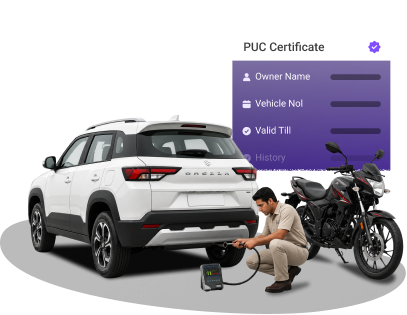
A Pollution Under Control Certificate or PUCC is a document that confirms your vehicle's emissions are within prescribed government limits. Your vehicle must pass the PUC test done at authorised PUC testing centres and petrol pumps to obtain this certificate. To find the nearest PUC testing centre, you can visit the official Parivahan portal.
What is the Validity of a PUC Certificate for a Vehicle?
If you have purchased a new vehicle, the PUC certificate is valid for one year. After one year, you must renew the certificate every six months. The PUCC is valid for six months for older vehicles, as they emit more pollutants due to engine wear and tear. The validity of a pollution certificate for vehicles with BS IV and BS VI emission norms is one year. And, electric vehicles are exempt from having a PUC certificate.
How to Check PUCC Validity Online via PB Wheels?
You can check the validity of your PUC certificate online through PB Wheels by following the steps given below:
-
Open the PB Wheels website and go to the 'Vehicle Details' option at the top
-
Click 'PUC Certificate' and enter your vehicle registration number
-
Click 'Check PUCC Status' to check the Certificate number and expiry date
Why Should You Have a PUC Certificate for a Vehicle?
It is important to have a valid PUC certificate because:
-
Mandatory by law: Under the Motor Vehicle Act (1988), a valid PUCC is legally necessary to drive your vehicle on Indian roads. Otherwise, you would have to pay a hefty penalty or challan. You must renew the pollution certificate before expiry to avoid challans and penalties.
-
Environmental protection: A valid PUC certificate ensures your vehicle's emissions are within government-set limits. This helps reduce overall pollution and carbon footprint and create a cleaner environment.
-
Insurance renewal: As per the Insurance Regulatory and Development Authority of India (IRDAI), all vehicle owners must have a valid PUC certificate to renew their motor insurance or settle claims.
-
Better vehicle health: To renew a PUC certificate every six months, you must have your vehicle checked for any engine or exhaust issues, including high emission levels. This helps you maintain the vehicle's health regularly.
What Does a Pollution Under Control Certificate Consist of?
The PUC certificate for your vehicle includes the following details:
- PUCC serial number
- Vehicle registration number
- Date of test
- Emission readings
- Validity of the PUC test
- Emission standards of the vehicle
- Issuing authority
How to Get a New PUC Certificate?
You must take your vehicle to the nearest PUC testing centre or petrol pump for a pollution check. Here, the amount of pollutants your vehicle emits is checked. Once your vehicle passes this test conducted by the PUC emission testing centre, you get a PUC certificate.
How to Locate a Nearby Pollution Testing Center?
You can find the nearest PUC centre on the Parivahan website by following the steps below:
-
Open the Parivahan Sewa portal (www.parivahan.gov.in) to find a test centre
-
Click 'PUCC' under the 'Online Services' tab
-
Hit 'PUC Centre List' at the top and choose your state and nearest office from the dropdown list
-
This will show you all the active PUC centres near you, along with their centre code, authorised name, complete address, and types of vehicles checked
-
You can also download this list in a PDF format for future reference
Note: The steps here outlined on this page are accurate as of the current date and based on the existing interface of the Parivahan website.
What is the Testing Procedure for Obtaining PUCC?
To obtain the PUC certificate, you must get your vehicle tested for emissions. The testing process for the same is as follows:
-
Take your vehicle to the PUC testing centre and position it as instructed by the operator
-
The operator analyses pollutants emitted by the vehicle's exhaust using an emission-testing device
-
If the readings fall within the permissible limits, a PUCC will be generated
-
Pay the required fee and collect your certificate
Types of Emission Tests Conducted at a PUC Testing Centre
Various types of vehicle emission tests conducted at a PUC testing centre are given below:
| Type of vehicle | Type of test | Description |
|---|---|---|
|
Petrol vehicles |
Carbon monoxide (CO) test | Measures engine performance and quality of fuel combustion |
| Carbon dioxide (CO₂) test | Measures the CO₂ emissions of the vehicle and assesses its impact on environmental health | |
| Hydrocarbon (HC) test | Measures the incomplete combustion of fuel that increases pollution | |
|
Diesel vehicles |
Idling CO test | Measures exhaust emissions while the engine runs at rest (no load) |
| Smoke density test | Measures the opacity of black smoke to evaluate combustion efficiency | |
|
CNG or LPG vehicles |
Hydrocarbon test | Measures the unburnt fuel residues to ensure efficient combustion and reduce pollution |
| Carbon monoxide test | Measures the efficiency of fuel combustion and engine condition |
PUC Certificate Fees
The charges for obtaining a PUC certificate vary by state and union territories. They are listed below:
| State | Vehicle Type | Fees |
|---|---|---|
| Chhattisgarh | Two-wheelers | Rs. 100 |
| Four-wheelers | Rs. 150 | |
| Delhi | Two-wheelers and three-wheelers - Petrol/CNG/LPG (including bi-fuel) | Rs. 60 |
| Four-wheelers and above - Petrol/CNG/LPG (including bi-fuel) | Rs. 80 | |
| All diesel vehicles | Rs. 100 | |
| Manipur | Two-wheelers (both petrol and diesel) | Rs. 50 |
| Four-wheelers/light motor vehicles (both petrol and diesel) | Rs. 75 | |
| Four-wheelers/medium motor vehicles (both petrol and diesel) | Rs. 85 | |
| Heavy vehicles (buses and trucks) | Rs. 100 | |
| Jammu and Kashmir | Two-wheelers (Petrol) | Rs. 50 |
| Three-wheelers (Petrol) | Rs. 60 | |
| Four-wheelers (Petrol) | Rs. 80 | |
| All diesel vehicles | Rs. 100 | |
| Assam | Two-wheelers | Rs. 60-100 |
| Four-wheelers | Rs. 80-120 | |
| Commercial vehicles | Rs. 100-200 | |
| Uttar Pradesh | Two-wheelers (Petrol) | Rs. 70 |
| Three and four-wheelers (Petrol/LPG/CNG) | Rs. 90 | |
| All diesel vehicles | Rs. 120 | |
| Bihar | Two-wheelers | Rs. 80 |
| Three-wheelers | Rs. 100 | |
| Four-wheelers | Rs. 120 | |
| Maharashtra | Two-wheelers | Rs. 60 |
| Three-wheelers (Petrol) | Rs. 120 | |
| Four-wheelers (CNG/Petrol) | Rs. 150 | |
| Diesel vehicles | Rs. 180 | |
| Karnataka | Two-wheelers | Rs. 80 |
| Three-wheelers | Rs. 80 | |
| Four-wheelers (Petrol/CNG/LPG) | Rs. 150 | |
| Four-wheelers (Diesel) | Rs. 200 | |
| Mizoram | Two-wheelers | Rs. 60 |
| Three-wheelers (Petrol) | Rs. 80 | |
| Three-wheelers (Diesel) | Rs. 100 | |
| Light motor vehicle (Petrol) | Rs. 120 | |
| Light motor vehicle (Diesel) | Rs. 150 | |
| Medium and heavy motor vehicles | Rs. 200 | |
| Himachal Pradesh | All petrol vehicles | Rs. 60 |
| All diesel vehicles | Rs. 60 | |
| Gujarat | Two-wheelers (including mopeds) | Rs. 30 |
| Three-wheelers (LPG/Petrol/Diesel) | Rs. 60 | |
| Light motor vehicles (CNG/LPG/Petrol) | Rs. 80 | |
| Light motor vehicles (Diesel) | Rs. 100 | |
| Medium and heavy motor vehicles (Diesel/CNG) | Rs. 100 | |
| Haryana | Two-wheelers | Rs. 50 |
| Three-wheelers and four-wheelers (Petrol/CNG/LPG) | Rs. 80 | |
| Four-wheelers (Diesel) | Rs. 100 | |
| Kerala | Two-wheelers | Rs. 80 |
| Light motor vehicles | Rs. 100 | |
| Puducherry | Two-wheelers | Rs. 60 |
| Four-wheelers | Rs. 100 | |
| Andaman and Nicobar Islands | Two-wheelers | Rs. 60 |
| Three-wheelers | Rs. 80 | |
| Four-wheelers (Petrol) | Rs. 80 | |
| Four-wheelers (Diesel) | Rs. 100 | |
| Commercial vehicles | Rs. 130-150 | |
| Tamil Nadu | Two-wheelers | Rs. 50-100 |
| Three-wheelers | Rs. 100-200 | |
| Four-wheelers | Rs. 100-200 | |
| Telangana | Two-wheelers (Petrol) | Rs. 50 |
| Three-wheelers (Petrol) | Rs. 60 | |
| Four-wheelers (Petrol) | Rs. 75 | |
| All diesel vehicles | Rs. 100 | |
| Tripura | Two-wheelers | Rs. 45 |
| Three-wheelers | Rs. 65 | |
| Four-wheelers | Rs. 90 | |
| Other vehicles | Rs. 100 | |
| Chandigarh | All vehicles | Rs. 50 |
| Uttarakhand | All vehicles | Rs. 100 |
| Punjab | Two-wheelers | Rs. 50 |
| Three-wheelers | Rs. 80 | |
| Four-wheelers (Petrol) | Rs. 80 | |
| Four-wheelers (Diesel) | Rs. 100 | |
| Four-wheelers (CNG/LPG) | Rs. 80 | |
| Odisha | Two-wheelers and three-wheelers | Rs. 60 |
| Light motor vehicles | Rs. 100 | |
| Medium and heavy motor vehicles | Rs. 150 | |
| Rajasthan | Two-wheelers | Rs. 50 |
| Three-wheelers (Petrol) | Rs. 70 | |
| Three-wheelers (Diesel) | Rs. 100 | |
| Four-wheelers (Petrol) - | Rs. 70 | |
| Four-wheelers (Diesel) | Rs. 100 | |
| Dadra and Nagar Haveli and Daman and Diu | Two-wheelers | Rs. 80 |
| Four-wheelers | Rs. 100 | |
| Madhya Pradesh | Two-wheelers | Rs. 200 |
| Three-wheelers | Rs. 250 | |
| Four-wheelers (Petrol) | Rs. 350 | |
| Four-wheeelers (Diesel) | Rs. 400 | |
| CNG/LPG | Rs. 350 | |
| Jharkhand | Two-wheelers | Rs. 50 |
| Four-wheelers | Rs. 100 | |
| Heavy vehicles, such as trucks and buses | Rs. 320 | |
| Goa | Two-wheelers (non-commercial) | Rs. 100 |
| Two-wheelers (commercial) | Rs. 160 | |
| Three-wheelers (non-commercial) | Rs. 100 | |
| Three-wheelers (commercial) | Rs. 160 | |
| Four-wheelers (non-commercial) | Rs. 140 | |
| Four-wheelers (commercial) | Rs. 200 | |
| Heavy motor vehicles (non-commercial) | Rs. 300 | |
| Andhra Pradesh | Two-wheelers (Petrol) | Rs. 15 |
| Three-wheelers and four-wheelers (Petrol) | Rs. 25 | |
| All diesel vehicles | Rs. 30 | |
| Arunachal Pradesh | Two-wheelers | Rs. 60-100 |
| Four-wheelers | Rs. 100-150 | |
| Meghalaya | Varies as per the vehicle and fuel type | Rs. 60-100 |
| Nagaland | Two-wheelers and four-wheelers (Varies as per fuel type) | Rs. 60-100 |
| Sikkim | Varies as per the vehicle and fuel type | Rs. 60-100 |
| West Bengal | Two-wheelers | Rs.60-100 |
| Four-wheelers | Rs. 80-120 | |
| Commercial vehicles | Rs. 100-200 | |
| Lakshadweep | Varies as per the vehicle and fuel type | Rs. 60-150 |
| Ladakh | Varies as per the vehicle and fuel type | Rs. 60-100 |
Note: The prices mentioned above are subject to change in accordance with the latest government notifications. Contact the nearest PUC centre for current charges in your state. For Chandigarh, Uttarakhand, Punjab, Rajasthan, Dadra and Nagar Haveli and Daman and Diu, Madhya Pradesh, Jharkhand, and Andaman and Nicobar Islands, the information is verified from local authorised PUC centres.For Lakshadweep, the fees mentioned above are in accordance with the Motor Vehicles Act.
How to Download a PUC Certificate?
Once your vehicle passes the emission test, you will get a PUC certificate. For pollution certificate download, follow the steps given below:
-
Open the Parivahan website (www.parivahan.gov.in)
-
Click 'PUCC' under the 'Online Services' section provided at the top
-
Hit 'PUC Certificate' and enter your Registration Number and the last five digits of the chassis number carefully
-
Enter the security code shown in the image and click 'PUC Details' for PUC certificate download
Note: The steps outlined on this page are accurate as of the current date and based on the existing interface of the Parivahan website.
What is the Penalty for an Expired PUC?
The penalties for driving without a valid PUCC vary by state. To avoid penalties and traffic challans, you must get your vehicle's air and fuel filters replaced regularly. The penalties for different states are:
| States | First Offense | Second Offense |
|---|---|---|
| Karnataka | Rs. 1,500-3,000, depending on the vehicle type | Rs. 1,500-3,000, depending on the vehicle type |
| Delhi | Rs. 10,000 | Rs. 10,000 |
| Uttar Pradesh | Rs. 1,000 | Rs. 2,000 |
| Madhya Pradesh | Rs. 1,000 | Rs. 2,000 |
| Bihar | Up to Rs. 5,000 | Up to Rs. 10,000 |
| Punjab | Rs. 5,000 | Rs. 10,000 |
| Rajasthan | Rs. 500-2,000, depending on the vehicle type | Rs. 1,000-4,000, depending on the vehicle type |
| Maharashtra | Up to Rs. 2,000 and DL suspension for 3 months | Up to Rs. 5,000 and DL suspension for 3 months |
| Kerala | Rs. 2,000 | Rs. 2,000 |
| Haryana | Rs. 10,000 | Rs. 10,000 |
| Odisha | Rs. 10,000 | Rs. 10,000 |
| West Bengal | Rs. 2,000 | Rs. 2,000 |
| Tamil Nadu | Rs. 10,000 | Rs. 10,000 |
| Gujarat | Rs. 1,000 | Rs. 2,000 |
| Assam | Rs. 1,000 | Rs. 2,000 |
| Goa | Rs. 10,000 | Rs. 10,000 |
| Jammu and Kashmir | Rs. 10,000 | Rs. 10,000 |
| Chhattisgarh | Rs. 10,000 | Rs. 10,000 |
| Uttarakhand | Rs. 2,500 | Rs. 5,000 |
| Manipur | Up to Rs. 10,000 | Up to Rs. 10,000 |
| Chandigarh | Rs. 2,000 | Rs 5,000 |
| Mizoram | Rs. 10,000, DL suspension for 3 months, and imprisonment for 3 months | Rs. 10,000 and imprisonment for 6 months |
| Himachal Pradesh | Rs. 10,000 | Rs. 10,000 |
| Jharkhand | Rs. 1,000 | Rs. 1,000 |
| Puducherry | Rs. 100 | Rs. 100 |
| Dadra and Nagar Haveli and Daman and Diu | Up to Rs. 3,000 | Up to Rs. 3,000 |
| Lakshadweep | Up to Rs. 10,000, depending on the vehicle type | Up to Rs. 10,000, depending on the vehicle type |
| Nagaland | Rs. 1,000 | Rs. 2,000 |
| Sikkim | Rs. 500 | Rs. 10,000 |
| Telangana | Rs 1,000 | Rs 1,000 |
| Tripura | Rs. 10,000 and DL suspension for 3-6 months | Rs. 10,000 and DL suspension for 3-6 months |
| Andaman and Nicobar Islands | Up to Rs. 10,000 | Up to Rs. 10,000 |
| Andhra Pradesh | Rs. 1,000 | Rs. 2,000 |
| Arunachal Pradesh | Rs. 1,000 | Rs. 2,000 |
| Meghalaya | Rs. 5,000 | Up to Rs. 10,000 |
| Ladakh | Rs. 1,000 | Rs. 1,000 |
Note: The above-mentioned penalties for driving without a valid PUC are subject to change per the recent government notifications. Visit your state's transport department or check its website to know the latest charges. For Lakshadweep, the fines mentioned above are in accordance with the Motor Vehicles Act.
FAQs on PUC Certificate
What is a PUC Document?
A PUC document verifies that your vehicle's emissions are within the limits prescribed by the government. This ensures that it doesn't contribute to increased pollution.
What is the Purpose of a PUC Certificate?
A valid PUC certificate ensures your vehicle does not emit excessive emissions that cause air pollution. It also helps you avoid traffic challans.
Do I Need A PUC Certificate for my Electric Vehicle?
No, you don’t need a PUCC for electric vehicles in India. This is because they run on battery power and don’t produce any emissions.
Can I Upload a PUC Certificate in DigiLocker?
Yes, you can upload a PUC certificate to DigiLocker. However, only the pollution certificate under the 'Issued Documents' section on DigiLocker is legally valid.
Can We Download a PUC Certificate?
Yes, you can download an active pollution certificate online through the Parivahan portal.
Does a PUCC Expire Every Year?
No, a PUCC doesn’t expire every year. Its validity depends on the age of the vehicle and its emission levels. For new vehicles, the validity is one year. After one year, the certificate generally expires every six months. For old vehicles, the validity period is six months.
What if My PUCC Has Expired?
You must renew the PUCC immediately if it has expired to avoid penalties.
What is the Fine if the PUC certificate Has Expired?
The fine for an expired PUC certificate varies by state and can range from Rs. 1,000 to Rs. 10,000.
How Do I Renew My PUC Certificate Online?
To renew your PUCC online, you need to visit the nearest PUC testing centre, which you can find using the Parivahan portal. Take our vehicle to the testing centre and carry your Registration Certificate (RC) and previous PUC certificate. If your vehicle passes the test, you can get a new pollution certificate after paying for the fees, either online or at the centre.